| Sign In | Join Free | My insurersguide.com |
|
| Sign In | Join Free | My insurersguide.com |
|
| Categories | Stainless Steel Sheet |
|---|---|
| Price: | Negotiable |
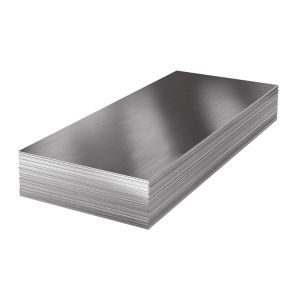
| Packaging Details: | Standard export sea-worthy packaging, wooden case or as your requirements for stainless steel sheet/plate |
| Delivery Time: | 15-21 work day |
| Payment Terms: | L/C,T/T,D/P,D/A,Western Union |
| Company Info. |
| Foshan Mellow Stainless Steel Co., Ltd. |
| Verified Supplier |
| View Contact Details |
| Product List |
Product Specifications
Product | |
Standard | ASTM,AISI,SUS,JIS,EN,DIN,BS,GB |
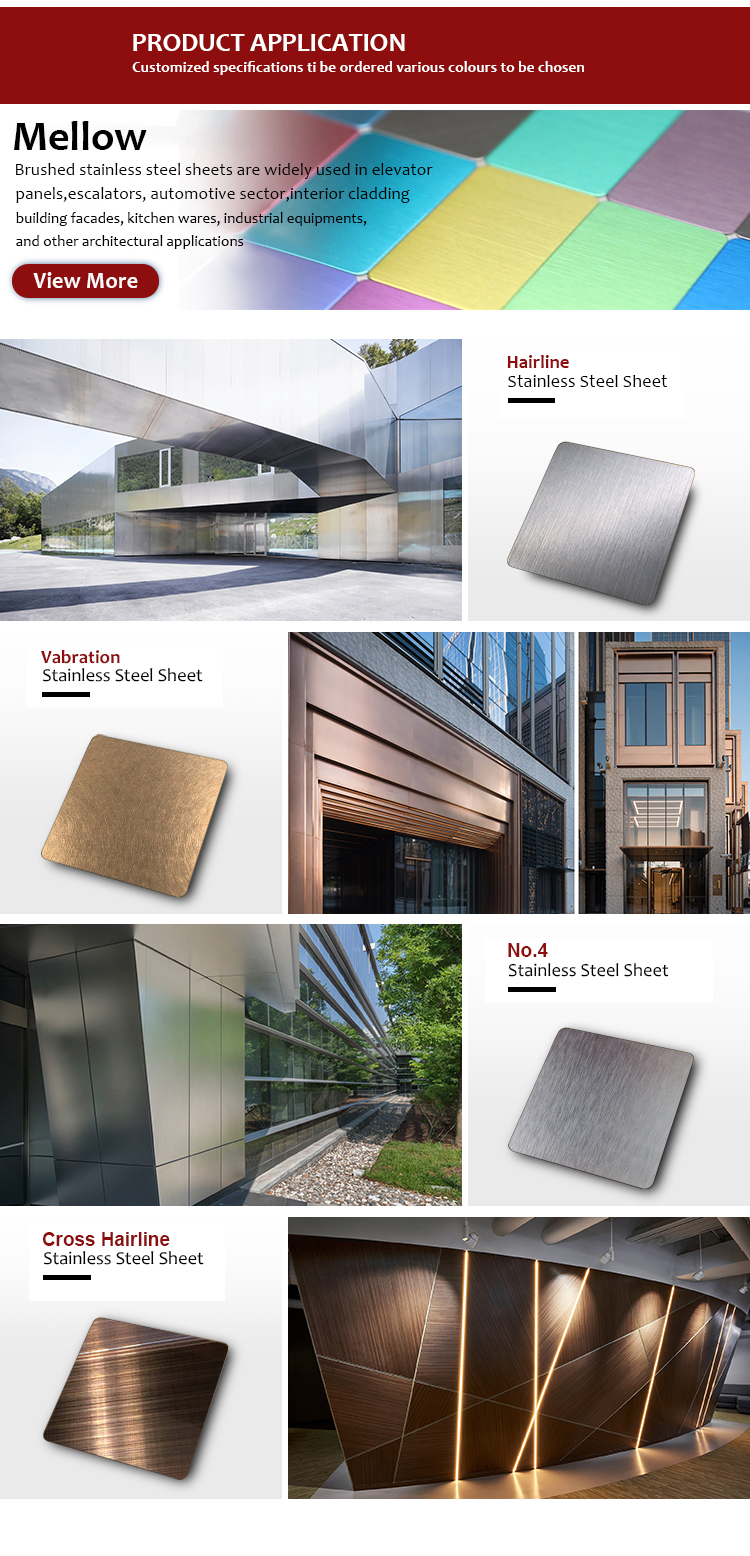
Finish(Surface) | BA, 2B, 4K, 6K, 8K, NO.4, HL, Embossed, Perforated, Pickling white, Polished outside, Polished inside and outside |
Technique | Hot Rolled / Cold Rolled |
Grade | 1020/1050/1060/1100/2011/2014/2017/2024/2A12/3003/3009/3A21/3A1 2/4004/4032/4047/5052/5083/5182/6061/6063/6082/7050/7A04 |
Standard Thickness | 1000mm/1250mm/1500mm, can be customized |
Standard Width | 1000mm/1250mm/1500mm, can be customized |
Additional Services | Welding/Punching/Cutting/Bending/Decoiling |
Package Details | Standard seaworthy package(protected by waterproof paper,wrapped in iron sheet, fixed by steel bars) |
Introduction of 316 stainless steel plate
Basic information
Material characteristics: 316 stainless steel plate belongs to
austenitic stainless steel, with good corrosion resistance, heat
resistance, low temperature strength and mechanical properties,
non-magnetic, and excellent work hardening.
Corresponding grades: domestic standard grade is 0Cr17Ni12Mo2,
American standard is SUS316, German/European standard is 1.4408.
Chemical composition
Main components: carbon (C) ≤0.08%, silicon (Si) ≤1.00%, manganese
(Mn) ≤2.00%, phosphorus (P) ≤0.035%, sulfur (S) ≤0.03%, chromium
(Cr) 16.00%-18.50%, nickel (Ni) 10.00%-14.00%, molybdenum (Mo)
2.00%-3.00%.
Element effect: Chromium can form a dense oxide film on the surface
of stainless steel to improve corrosion resistance; nickel can
enhance the toughness and corrosion resistance of stainless steel,
so that stainless steel can maintain good performance even in low
temperature environment; the addition of molybdenum further
improves the corrosion resistance of stainless steel under
harshconditions, especially the resistance to chloride pitting and
crevice corrosion.
Physical properties
Density: about 7.98g/cm³.
Melting point: between 1398-1420℃.
Specific heat capacity: 0.502J/(g・℃) at 20℃.
Thermal conductivity: 12.1W/(m・℃) at 20℃, and the thermal
conductivity will increase with the increase of temperature.
Linear expansion coefficient: 16.0×10⁻⁶/℃ at 20℃-100℃, and the
linear expansion coefficient will gradually increase with the
increase of temperature.
Resistivity: about 0.73Ω・mm²/m.
Longitudinal elasticmodulus: about 193kN/mm² at room temperature.
Mechanical properties
Specified non-proportional extension strength Rp0.2: not less than
310MPa.
Tensile strength Rm: not less than 620MPa.
Elongation after fracture A: not less than 30%.
Shrinkage surface after fracture Zc: not less than 40%.
Hardness: Brinell hardness HBW not more than 217, Rockwell hardness
HRB not more than 95, Vickers hardness HV not more than 220.
Processing technology
Melting: Put high-quality chromium iron, nickel iron, molybdenum
iron and other alloy raw materials and waste stainless steel into
an arc furnace or induction furnace in a certain proportion for
melting. By controlling the temperature, atmosphere and melting
time in the furnace, various elements are fully fused to form a
uniform steel liquid.
Refining: Use refining processes such as argon oxygen
decarburization (AOD) and vacuum oxygen decarburization (VOD) to
further reduce the carbon content in the molten steel, remove
harmful impurities, adjust the content of alloying elements, and
improve the purity and quality of the molten steel.
Casting: The refined molten steel is cast into a pre-designed mold,
and after cooling and solidification, it forms a stainless steel
slab. Common casting methods include continuous casting and die
casting. Continuous casting has the advantages of high production
efficiency and low cost, while die casting is suitable for
producing slabs with some special specifications and high quality
requirements.
Rolling: It includes two stages: hot rolling and cold rolling. Hot
rolling is to heat the slab to a high temperature and then roll it
through a rolling mill to gradually reduce its thickness and
increase its width and length; cold rolling is to further roll the
hot-rolled steel plate at room temperature to obtain higher
dimensional accuracy, surface quality and mechanical properties.
Surface treatment: In order to meet different usage requirements, 316 stainless steel plates also need various surface treatments, such as polishing, frosting, wire drawing, titanium plating, etc., to improve their aesthetics, corrosion resistance and wear resistance.
Corrosion resistance
Acid and alkali resistance: 316 stainless steel plate has good
corrosion resistance in most organic acids, inorganic acids and
alkaline solutions. For example, in acidic environments such as
sulfuric acid, hydrochloric acid, and nitric acid, its corrosion
resistance is significantly better than that of ordinary stainless
steel.
Pitting resistance: Due to the addition of molybdenum, the pitting
resistance of 316 stainless steel plate has been significantly
improved, and it can effectively resist pitting caused by corrosive
media such as chloride ions. It has a wide range of applications in
marine environments, chemical equipment and other fields.
Stress corrosion resistance: It has good resistance to stress corrosion cracking, and can resist the erosion of corrosive media while bearing a certain stress, thereby avoiding the occurrence of stress corrosion cracking and improving the safety and reliability of equipment.
Application field
Chemical field: used to manufacture chemical reactors, storage
tanks, pipelines and other equipment, which can resist the erosion
of various corrosive chemicals and ensure the safety and stability
of chemical production.
Marine field: such as seawater desalination equipment, hull
structure of marine ships, seawater aquaculture equipment, etc.,
the seawater corrosion resistance of 316 stainless steel plate
enables it to be used for a long time in the marine environment.
Food and beverage industry: food processing equipment, beverage
canning lines, storage containers, etc., its good corrosion
resistance and hygienic performance can ensure the quality and
safety of food and beverages and meet relevant hygiene standards.
Medical field: manufacturing medical equipment, hospital
facilities, etc., such as surgical instruments, medical equipment
shells, hospital handrails, etc., with good corrosion resistance
and biocompatibility.
Building decoration field: used for exterior wall decoration,
roofs, stair handrails, railings, etc. of buildings, its beautiful
appearance and excellent corrosion resistance can improve the
overall quality and service life of the building.
Electronic and electrical field: electronic equipment shells, radiators, wire pipes, etc., the good conductivity, thermal conductivity and corrosion resistance of 316 stainless steel plates can meet the performance requirements of electronic and electrical equipment.


|
 ODM 201 304 430 316 Cold Rolled Metal Stainless Steel Sheet Plate 2mm
316L 410 Cold Rolled Frosted 4mm Stainless Steel Plate Sheet Decorative Panels
Cold Rolled 8K Mirror Finish SS Sheet 304 316 430 OEM For Household Items
8K Hot Rolled 5x10 Stainless Steel Sheet Plate 4mm 304SS 316SS 430SS
Hot Rolled 201 304 430 316 4x8 Stainless Steel Sheet Plate Welding Metal
Industrial HR CR Frosted 304 Stainless Steel Sheet Thick 201 304 430 316
304 316L Stainless Steel Cold Rolled Sheet Plate 3mm For Wall Cladding
SS201 304SUS SS430 Stainless Steel Sheet Metal Hot Rolled Mirror Plate 0.3 - 3.0mm
ODM 201 304 430 316 Cold Rolled Metal Stainless Steel Sheet Plate 2mm
316L 410 Cold Rolled Frosted 4mm Stainless Steel Plate Sheet Decorative Panels
Cold Rolled 8K Mirror Finish SS Sheet 304 316 430 OEM For Household Items
8K Hot Rolled 5x10 Stainless Steel Sheet Plate 4mm 304SS 316SS 430SS
Hot Rolled 201 304 430 316 4x8 Stainless Steel Sheet Plate Welding Metal
Industrial HR CR Frosted 304 Stainless Steel Sheet Thick 201 304 430 316
304 316L Stainless Steel Cold Rolled Sheet Plate 3mm For Wall Cladding
SS201 304SUS SS430 Stainless Steel Sheet Metal Hot Rolled Mirror Plate 0.3 - 3.0mm