| Sign In | Join Free | My insurersguide.com |
|
| Sign In | Join Free | My insurersguide.com |
|
| Categories | Sapphire Tube |
|---|---|
| Brand Name: | ZMSH |
| Place of Origin: | China |
| MOQ: | 1 |
| Price: | by case |
| Payment Terms: | T/T |
| Supply Ability: | By case |
| Delivery Time: | 2-4 weeks |
| Packaging Details: | custom cartons |
| Manufacturing Method: | KY (Kyropoulos) |
| Nominal Size: | OD 20 mm × ID 16 mm × L 60 mm |
| Concentricity / Straightness*: | ≤0.05 mm / ≤0.05 mm per 60 mm |
| Density: | 3.97–3.98 g/cm³ |
| Melting Point: | 2053 °C |
| Recommended Max Service Temp: | ~1600 °C (air); up to ~1900–2000 °C (inert/vacuum)** |
| Company Info. |
| SHANGHAI FAMOUS TRADE CO.,LTD |
| Verified Supplier |
| View Contact Details |
| Product List |
Our transparent sapphire tube (OD 20 mm × ID 16 mm × Length 60 mm), grown by the KY (Kyropoulos) method, is engineered for harsh environments where optical clarity, high temperature resistance, and superior wear performance are critical.
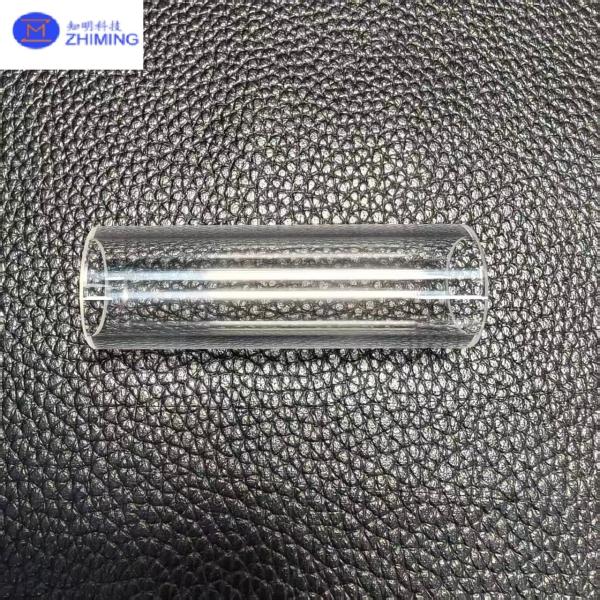

We support customized tolerances, surface finishes, coatings, and
crystal orientations to meet diverse application needs.

With a Mohs hardness of 9, second only to diamond, sapphire delivers outstanding scratch and wear resistance. The tube maintains dimensional stability and surface integrity under high mechanical stress, particle erosion, and frequent handling.
Thanks to sapphire’s excellent mechanical strength and chemical stability, the tube performs reliably at elevated temperatures and resists attack from acids, alkalis, and most organic solvents—ideal for demanding optical and process environments.
Widely deployed in optical instruments, chemical processing equipment, semiconductor tools, biomedical devices, and high-temperature furnaces, our sapphire tubes consistently deliver high quality and dependable performance.
 High Hardness
Mohs 9 hardness provides exceptional scratch and abrasion resistance, preserving optical clarity and surface finish in challenging
conditions.
Wear & Erosion Resistance
Maintains surface finish and structural integrity under prolonged use with particulates, high-velocity flows, or
repeated cleaning.
Chemical Resistance
Excellent resistance to acids, alkalis, and solvents, minimizing corrosion, contamination, and maintenance downtime.
High Temperature Capability
Sapphire melts at 2053 °C. Typical service limits: up to ~1600 °C in air; up to ~1900–2000 °C in inert gas/vacuum (application-dependent). Suitable for thermal cycling with proper
ramp rates.
Optical Clarity
High transmission from UV to IR, enabling use as sight tubes, windows, and protective sleeves in optical and laser systems.
| Item | Parameter |
|---|---|
| Product | Sapphire Tube (Transparent) |
| Manufacturing Method | KY (Kyropoulos) |
| Nominal Size | OD 20 mm × ID 16 mm × L 60 mm |
| Standard Tolerances* | OD/ID ±0.05 mm (to ±0.02 mm on request); L ±0.20 mm (to ±0.05 mm) |
| Concentricity / Straightness* | ≤0.05 mm / ≤0.05 mm per 60 mm |
| End Faces | Deburred chamfer; matt ground or optically polished |
| Optional Coatings | AR (custom band), protective, anti-smudge |
| Crystal Structure | Hexagonal (α-Al2O3) |
| Density | 3.97–3.98 g/cm³ |
| Melting Point | 2053 °C |
| Recommended Max Service Temp | ~1600 °C (air); up to ~1900–2000 °C (inert/vacuum)** |
| Specific Heat (25 °C) | ~0.75 J/(g·K) |
| Dielectric Strength | ~48 MV/m |
| Dielectric Constant (20 °C) | ~9.3 (at MHz) |
| Dielectric Loss (20 °C) | <1.4 × 10⁻⁴ (at MHz) |
| Volume Resistivity | >1.0 × 10¹⁴ Ω·cm (20 °C); ~1.0 × 10¹¹ Ω·cm (500 °C) |
* Tolerances are configurable; please specify your metrology
standard.
** Final limits depend on atmosphere, heat flux, wall thickness,
and thermal gradients.
Laser Systems – Protective sleeves and sight tubes for high-power optics; stable under thermal loading.
Optical Instruments – Windows/tubes for spectrometers, cameras, and telescopes with minimal distortion.
Chemical Processing – Corrosion-resistant viewing and sampling tubes for acids/alkalis and aggressive media.
High-Temperature Furnaces – Protective sheaths for thermocouples and heating elements; clear flame/charge observation.
Biomedical Devices – Biocompatible, corrosion-resistant housings and sleeves for surgical tools and sensors.
Semiconductor Manufacturing – Chemically inert, electrically insulating tubes for wafer processing equipment.
R&D – Durable, optically clear components for spectroscopy, materials testing, and high-T reactions.
Q1: What tolerances can you achieve on OD/ID/Length?
A: Standard: OD/ID ±0.05 mm, Length ±0.20 mm. Precision on request:
OD/ID ±0.02 mm, Length ±0.05 mm. Concentricity ≤0.05 mm and
straightness ≤0.05 mm/60 mm are available with precision grinding.
Q2: Can the end faces be optically polished?
A: Yes. Options include matte ground, single-side or double-side
optical polish (Ra ≤10 nm). Chamfers and deburring are standard.
Q3: Do you offer AR coatings? Which wavelengths?
A: Yes—single or multi-band AR coatings from UV to IR (e.g., 355 nm,
532 nm, 633 nm, 1064 nm, 1550 nm). Protective/anti-smudge coatings
are also available.
Q4: What is the usable temperature range?
A: Continuous service typically up to ~1600 °C in air, and up to
~1900–2000 °C in inert gas/vacuum (application-dependent). Melting
point is ~2053 °C.
Q5: How about thermal shock resistance?
A: Sapphire handles rapid cycling better than glass, but it is still
a brittle ceramic. We recommend controlled ramp rates and avoiding
sudden quenching—final limits depend on wall thickness and
gradients.
Q6: Is the tube resistant to chemicals?
A: Yes. Excellent resistance to acids, alkalis, water, and most
solvents. Avoid hot hydrofluoric acid or strong molten
alkalis/salts.

|
 Polished Transparent Sapphire Tube KY Method Customized Size High Hardness High Wear Resistance
1 *11mm Sapphire Components Monocrystalline Polycrystalline Silicon Rods Discharge Electrode Needle
Polished Surface Sapphire Glass Rod With Straight Flange 9.0 Hardness High Purity
Corrosion Resistance Sapphire Components Polished Surface Rolling Bearing Components
Round Sapphire Glass Lens Assembly Part With Sink Hole High Thermal Conductivity
Hardness 9.0 Sapphire Components Sapphire Optical Ring Glass High Temperature Abrasion Resistance
Flow Control Sapphire Tube Rods Protective Insulating Instrument Quartz Tube
High Temperature Resistance Sapphire Tube 50.4mm Large Diameter KY Sapphire Rods
25-500um Sapphire Fiber Optic Cable Communication Line Alumina Fiber Single Crystal Al2O3
High Hardness Sapphire Tube Anti-Scratch Tube Shape Transparent high hardness
Polished Transparent Sapphire Tube KY Method Customized Size High Hardness High Wear Resistance
1 *11mm Sapphire Components Monocrystalline Polycrystalline Silicon Rods Discharge Electrode Needle
Polished Surface Sapphire Glass Rod With Straight Flange 9.0 Hardness High Purity
Corrosion Resistance Sapphire Components Polished Surface Rolling Bearing Components
Round Sapphire Glass Lens Assembly Part With Sink Hole High Thermal Conductivity
Hardness 9.0 Sapphire Components Sapphire Optical Ring Glass High Temperature Abrasion Resistance
Flow Control Sapphire Tube Rods Protective Insulating Instrument Quartz Tube
High Temperature Resistance Sapphire Tube 50.4mm Large Diameter KY Sapphire Rods
25-500um Sapphire Fiber Optic Cable Communication Line Alumina Fiber Single Crystal Al2O3
High Hardness Sapphire Tube Anti-Scratch Tube Shape Transparent high hardness

