| Sign In | Join Free | My insurersguide.com |
|
| Sign In | Join Free | My insurersguide.com |
|
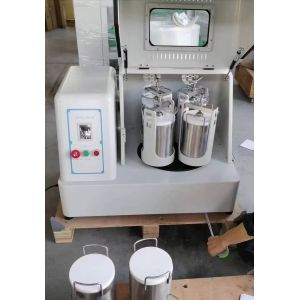
| Categories | Planetary Ball Mill Machine |
|---|---|
| Brand Name: | Zoli |
| Model Number: | XQM |
| Certification: | ISO 9001 CE |
| Place of Origin: | China |
| MOQ: | 1 set |
| Payment Terms: | L/C,T/T,Western Union |
| Supply Ability: | 200 units per month |
| Delivery Time: | within 15days |
| Packaging Details: | carton+wood |
| Maximum Loading Capacity: | 2/3 capacity of the grinding jar |
| Grindingjarvolume: | 250 ml |
| Control Type: | Digital / Manual |
| Model: | QM-3SP2 |
| Final Fineness: | 1μm |
| Rotation Speed: | 0-1160 rpm |
| Grinding Ball Size: | 10 mm |
| Feeding Granularity: | <=1mm |
| Working Principle: | Planetary Motion |
| Voltage: | 220 V / 50 Hz |
| Timerrange: | 0-99 minutes |
| Rotation Direction: | Forward/Reverse |
| Grinding Jar Material: | Stainless Steel |
| Application: | Mixing, Grinding, Blending of materials |
| Grinding Balls Diameter: | 10mm |
| Company Info. |
| Guangzhou Zoli Technology Co.,Ltd. |
| Verified Supplier |
| View Contact Details |
| Product List |
Integrated Conceptual Overview
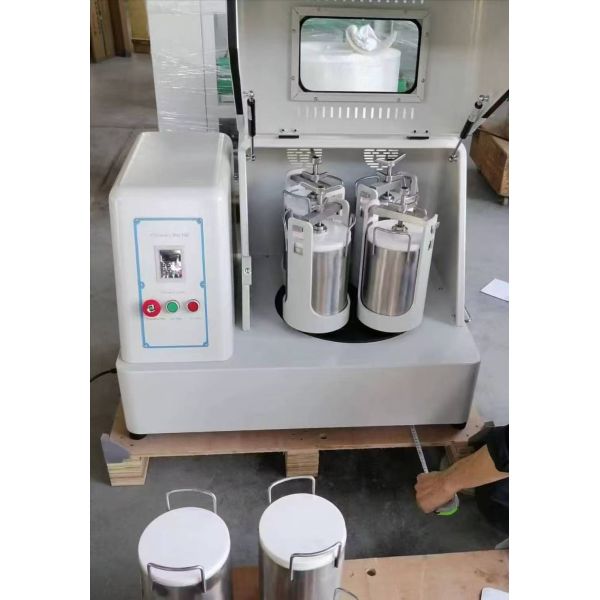
A "Vertical planetary ball mill laboratory small agate zirconia medium grinding instrument" is a compact, high-performance grinding system characterized by its space-saving vertical design and its use of high-purity, contamination-resistant grinding materials (Agate and Zirconia). It is engineered for applications where sample purity, minimal cross-contamination, and precise nano-scale grinding are paramount.
1. The "Vertical" Design: Key Features and Advantages
Unlike traditional planetary mills where the grinding platform rotates in a horizontal plane, a vertical mill has its central axis oriented vertically.
2. The Premier Grinding Media: Agate vs. Zirconia
The specification of Agate and Zirconia highlights a focus on ultra-high purity grinding. The choice between them is critical and depends on the application's primary need.
| Feature | Agate (Natural SiO₂) | Zirconia (ZrO₂ - Yttria Stabilized) |
|---|---|---|
| Hardness (Mohs) | ~7 (Hard) | ~9 (Very Hard) |
| Key Advantage | Best-in-class Purity & Low Contamination. Chemically inert. | Superior Grinding Efficiency & Durability. Extreme toughness. |
| Best For | Contamination-Sensitive Applications: Geochemistry, isotope analysis, environmental science, preparing samples for trace element analysis (e.g., ICP-MS). | Hard & Abrasive Materials: Ceramics, minerals, soils, pharmaceuticals, metals. Where speed and fineness are the top priorities. |
| Primary Consideration | Softer than Zirconia, so it wears faster and is less efficient for extremely hard materials. | Can introduce trace Zr/Y contamination, which may be unacceptable for certain trace-level silicate analysis. |
In practice: A lab might use Agate jars and balls for preparing geological samples for precise silica content or trace lead isotope analysis, and Zirconia jars and balls for rapidly grinding down hard pharmaceutical compounds or engineering ceramics to the nanoscale.
3. "Laboratory Small" and "Medium Grinding Instrument"
Laboratory Small: Reiterates this is a benchtop instrument for R&D, not production. Typical jar sizes range from 0.1L to 2L, with sample loads from a few grams to a few hundred grams.
Medium Grinding Instrument: The term "medium" here most likely refers to the Grinding Media itself—the balls or cylinders inside the jar. It specifies that the machine is designed to use these "mediums" (Agate or Zirconia) to perform the grinding action.
4. Typical Specifications and Workflow
A vertical planetary ball mill of this type would typically feature:
Workflow Example: Preparing a Geological Sample for XRD


|
 Compact Micro Planetary Ball Mill Machine For Alloy Nanoparticles 110V
XQM-4L Experimental Vertical Planetary Ball Mill
nano-scale powder ceramic planetary ball mill small rapid laboratory ball mill
Laboratory small planetary ball mill,dry and wet pulverizer, nano sample preparation,silent soil grinding
ZOLI Bench-top Size Designed For Laboratory Research And Development
High Energy Laboratory Planetary Small Sample Preparation Grinding Machine
Compact Laboratory Planetary Ball Mill Emi-circular Grinding Jar Design
Versatile And High-performance 1L Laboratory Nano-Scale Ball Mill With 100ml Zirconia Tank
Planetary Ball Mill with Zirconia Tank Precision Laboratory Grinding Instrument
Planetary Ball Mill Small Laboratory Dry And Wet Dual-purpose Agate Grinding Jar
Compact Micro Planetary Ball Mill Machine For Alloy Nanoparticles 110V
XQM-4L Experimental Vertical Planetary Ball Mill
nano-scale powder ceramic planetary ball mill small rapid laboratory ball mill
Laboratory small planetary ball mill,dry and wet pulverizer, nano sample preparation,silent soil grinding
ZOLI Bench-top Size Designed For Laboratory Research And Development
High Energy Laboratory Planetary Small Sample Preparation Grinding Machine
Compact Laboratory Planetary Ball Mill Emi-circular Grinding Jar Design
Versatile And High-performance 1L Laboratory Nano-Scale Ball Mill With 100ml Zirconia Tank
Planetary Ball Mill with Zirconia Tank Precision Laboratory Grinding Instrument
Planetary Ball Mill Small Laboratory Dry And Wet Dual-purpose Agate Grinding Jar